 |


Making time and marking milestones
|
|
|
|
Making time and marking milestones
Any piece of criminological research, including a dissertation, requires good time management. At the outset, you will feel as though you have lots of time as dis- sertations tend to have long lead in times with the hand-in date a considerable way off. This time should be used well to undertake the things detailed in the para- graphs and sections above, including identifyting the topic, formulating your question(s), reviewing the literature, and, as the next section details, exploring access, sampling and data collection approaches. Setting yourself a timetable is useful in providing an understanding of the key tasks that need doing and by when. You will need to allow for slippage by identifying periods of extra time in your planning.
It is also essential to get into good habits from the beginning, for example by keep- ing a research diary. A research diary can be used to record your first thoughts, day-to-day activities, insights, decision making and anxieties as the research unfolds
and progresses. The diary can also be used as a reflective tool and as a source of data, filling in elements of the research context, reminding you of particular incidents and aspects of fieldwork, sampling and data collection (Bowen, 1997; Meloy, 2002). Reflecting at the end of each week using your timetable and research diary will enable you to identify or anticipate problems in each of these areas. Table 2. 1 pro- vides an example of a simple research timetable.
TABLE 2. 1 Research timetable
| Month | S | O | N | D | J | F | M | A | M |
| Define topic/formulate research questions | |||||||||
| Undertake literature search and review | |||||||||
| Develop data collection tools and data analysis approaches | |||||||||
| Enter the field | |||||||||
| Identify and contact participants for research purposes | |||||||||
| Engage in carrying out the research | |||||||||
| Undertake data write-up (transcription of interviews etc. ) | |||||||||
| Analyse data and search further the literature | |||||||||
| Write up the dissertation and ensure university guidelines are met | |||||||||
| Hand in the dissertation with time for it to be printed and bound |
MAKING CONNECTIONS: PROPOSING DATA COLLECTION METHODS
|
|
|
 You will by now have a good idea of what it is you want to research for your disserta- tion and why. You may have also started to think about how you want to achieve it. That is, you may well have started to make connections between getting started – planning criminological research, and research design – proposing data collection methods.
For some of you, given the formulation of your research question and the pur- pose and outcome of your research, your dissertation will take the form of a literature review. Your aim will be to develop further your knowledge and under- standing of the literature on your chosen topic and research question, identifying the relevant databases that you will search and constructing a range of search terms and phrases to identify appropriate research material. Your dissertation research proposal or plan will articulate the way in which you will search, sift and review the literature (see Alison Wakefield in Chapter 3).
Proposing secondary or primary research
For those of you drawn to the excitement of doing research in the field, or because it is stipulated in your dissertation guidelines, whilst you will continue to review the research literature, your research question(s) will be formulated with the intention of doing fieldwork. You will therefore also have to think carefully about your approach to data collection and analysis. Secondary data analysis or primary research can add important elements to your research but only if they are appropriate to your pro- posed research questions (see Chapter 4 by Hannah Bows). In making connections between the what (topic area and research question(s)) and the how (research design and methods of data collection), you should be starting to think about the following questions:
· Will the approach adopted help answer the question that is the subject of your dissertation?
· Is it feasible to undertake, given the time and resources available to you as an undergraduate/postgraduate student?
· Can you ensure that it will be methodologically sound?
· Does it conform to School or Faculty and university ethics policies?
 You may decide to use data that is already available. Much of this will be secondary data in that it has been collected and collated by someone else. For Jupp et al. (2000: 62), secondary data and analysis:
refer to a form of inquiry and analysis based entirely on pre-existing data sources … A secondary source is an existing source of information which has been collected by someone other than the researcher and with some purpose other than the current research problem in mind.
 Data that is not available from a secondary source, or which is available but is inac- curate, unreliable or invalid, will have to be collected using primary research techniques. This is often called primary data collection and refers to the process whereby you collect the data yourself. When primary data collection is deemed an appropriate option for data collection, validity, reliability and accuracy are also important factors that you will need to take into account. Primary data can be col- lected in many ways including through the use of questionnaires, activity diaries, interviews, focus groups and by means of observation.
|
|
|

 The key questions that you will be faced with at this stage of planning your research are what type of data do you wish to collect, and what is the most appropriate way to do so. The quantitative approach to collecting data is about counting, ranking and ordering in a systematic way (Denscombe, 2017). It is used to answer predetermined questions, such as the percentage of people who are satisfied with the police or are fearful of crime (see, for example, Deakin and Spencer in Chapter 9 of this book). Quantitative data collection generally involves statistics and seeks to be reliable (that is, the same results would be produced if the data was collected again). Qualitative data is about people’s attitudes, motives and behaviours. This is useful if, for example, you are interested in exploring the views of drug users or the views of students in relation to their offending behaviour. If you have focused your research topic and have devel- oped a degree of specificity as outlined above, the questions that you have already identified should help inform selection of the most appropriate data that you need and point you towards the methodological approaches (and methods) relevant for their col- lection and analysis. Davies (2007: 26) suggests that where your dissertation aims to:
·  describe, monitor and investigate: both qualitative and quantitative research can provide evidence, although with different descriptions
· explore: it depends on the form of exploration, but both quantitative and qualita- tive research can be used, but will produce different exploratory material
· interpret: qualitative research is especially strong here
· look beyond the surface: this is usually undertaken using qualitative research
· evaluate: if it concerns replication and quantification, then quantitative research is appropriate, although if the aim is to evaluate perspectives then qualitative forms can be used
· explain: both quantitative and qualitative approaches can be used
· prove: it is mostly a quantitative approach, but can involve qualitative approaches.
Quantitative data and qualitative data are available from many sources. Box 2. 5 sets out some approaches to data collection that you may wish to consider in planning your research.
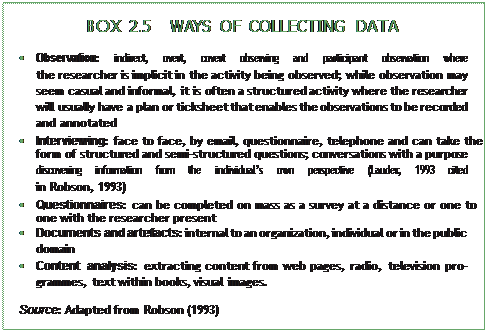
However, remember that each source of data and collection method outlined in Box 2. 5 has particular strengths and weaknesses (see Box 2. 6).
 |
|
|
|
