 |


1. Essential Course. Основной курс. 1. a) Cover the right column and read the English words. Translate them into Russian and check your translation.
|
|
|
|
1. Essential Course
Основной курс
Unit One [1]
1. a) Cover the right column and read the English words. Translate them into Russian and check your translation.
b) Cover the left column and translate the Russian words back into English.
| addition | [ə ˈ dɪ ʃ ə n] | сложение |
| subtraction | [sə bˈ træ kʃ n] | вычитание |
| plus | [plʌ s] | плюс |
| minus | [ˈ maɪ nə s] | минус |
| to add | [æ d] | складывать, прибавлять |
| to subtract | [sə bˈ træ kt] | вычитать |
| to equal | [ˈ iː kwə l] | равняться |
| to be equal | быть равным |
Addition and Subtraction
| 5 + 7 = 12 | – five plus seven equals twelve |
| 66 + 13 = 79 | – sixty-six plus thirteen is equal to seventy-nine |
| a + b = c | – a plus b is equal to c |
| 15 - 6 = 9 | – fifteen minus six equals nine |
| 81 - 33 = 48 | – eighty-one minus thirty-three is equal to forty-eight |
| c - b = a | – c minus b equals a |
2. Solve these problems and read them:
| 99 + 77 = ___________ | 8 - 3 = ______________ | 315 + 145 = _________ |
| 61 - 50 = ____________ | 47 - 18 = ____________ | 859 - 600 = __________ |
| 114 + 316 = _________ | 1, 203 + 419 = ________ | 4, 444 + 7, 777 = ______ |
| b + d = _____________ | d - c = ______________ | а - b = ______________ |
3. Pair work. Think of six problems of your own. Put them down. Ask your groupmate to solve them.
Unit Two [2]
1. a) Cover the right column and read the English words. Translate them into Russian and check your translation.
b) Cover the left column and translate the Russian words back into English.
| multiplication | [ˌ mʌ ltɪ plɪ ˈ keɪ ʃ n] | умножение |
| to multiply | [ˈ mʌ ltɪ plaɪ ] | умножать |
| multiplied by | умноженное на | |
| once | [wʌ ns] | один раз |
| twice | [twaɪ s] | дважды, два раза |
| three times | три раза | |
| four times | четыре раза | |
| division | [dɪ ˈ vɪ ʒ n] | деление |
| to divide | [dɪ ˈ vaɪ d] | делить |
| divided by | деленное на |
Multiplication and Division
| 1 × 1 = 1 | – once one is one |
| 2 × 2 = 4 | – twice two is four |
| 3 × 3 = 9 | – three times three equals nine |
| 4 × 4 = 16 | – four times four is equal to sixteen |
| 12 × 10 = 120 | – twelve multiplied by ten (by) is equal to one hundred and twenty |
| a × b = ab | |
| 35: 7 = 5 | – thirty-five divided by seven equals five |
| 1000: 25 = 40 | – one thousand divided by twenty-five is equal to forty |
| d: b = c |
|
|
|
2. Solve these problems and read them:
| 10 × 7 = _______ | 49: 7 = _______ | 13 × 3 = _______ | 749: 7 = ______ |
| 100 × 100 = ____ | 175: 25 = _____ | 618: 6 = ______ | 3, 550 × 5 = ____ |
| 234 × 6 = ______ | 12 × 12 = ______ | 33: 33 = ______ | 10, 660: 10 = ___ |
| b × c = ________ | n: m = ________ | 1 × k = ________ | 1 × 1= ________ |
3. Pair work. Think of five problems of your own. Put them down. Ask your groupmate to solve them.
Unit Three [3]
1. a) Cover the right column and read the English words. Translate them into Russian and check your translation.
b) Cover the left column and translate the Russian words back into English.
| fractions | [ˈ fræ kʃ ə nz] | дроби |
| decimal fractions | [ˈ desɪ mə l ˈ fræ kʃ ə nz] | десятичные дроби |
| common fractions | [ˌ kɔ mə n ˈ fræ kʃ ə nz] | простые дроби |
| numerator | [ˈ njuː mə reɪ tə ] | числитель |
| denominator | [dɪ ˈ nɔ mɪ neɪ tə ] | знаменатель |
| nought | [nɔ ː t] | нуль |
| zero | [ˈ zɪ ə rou] | нуль |
| [ou] | нуль | |
| point | [pɔ ɪ nt] | точка |
Common and Decimal Fractions
(see page 98)
|
| 0. 7 |
| 0 point seven | ||
| - one half (a half) | nought point seven | ||||
| zero point seven | |||||
|
|
| ||||
| - one third (a third) | 0. 002 - zero point two zeros two | ||||
|
| |||||
| - two sevenths | 1. 1 - one point one | ||||
|
| |||||
| - three and a half | 5. 36 - five point three six | ||||
|
| |||||
| - five and a seventh | 65. 57 - sixty-five point five seven | ||||
|
| |||||
| - six and five sevenths | |||||

2. Read these common and decimal fractions:
| 1/3 | 2/5 | 5/8 | 7 1/2 | 9 5/8 | 15 8/9 |
| 0. 23 | 0. 009 | 10. 01 | 205. 35 | 79. 31 | 0. 0003 |
Unit Four [4]
1. a) Cover the right column and read the English words. Translate them into Russian and check your translation.
b) Cover the left column and translate the Russian words back into English.
| current | [ˈ kʌ rə nt] | электрический ток |
| resistance | [rɪ ˈ zɪ stə ns] | сопротивление |
| voltage | [ˈ voultɪ dʒ ] | вольтаж, напряжение |
| to suppose | [sə ˈ pouz] | предполагать |
| law | [lɔ ː ] | закон |
|
|
|
Ohm’s Law
| R = | V | Resistance equals voltage divided by current. | |
| I | |||
|
| |||
| I = | V | Current equals voltage divided by resistance | |
| R | |||
|
| |||
| V = IR | Voltage equals current times resistance. | ||
|
Problem Suppose that resistance equals one volt and current equals one ampere. How much is the resistance? |
Solution
| |||||||
| V = 1V I = 1 amp R =? |
2. Solve the following problems and read them.
Model: – How much is 10 times 4?
– 10 times 4 equals 40.
| 1) 7 × 7 = | 5) 350 × 2 = | 9) 49: 7 = | 13) 20. 2530 |
| 2) 2. 5 × 3 = | 6) 3. 5 × 10 = | 10) 75: 25 = | 14) 7. 5: 5 = |
| 3) 10, 050 × 2 = | 7) 2, 000 × 5 = | 11) 3, 500: 35 = | 15) 40. 8: 4 = |
| 4) 100 × 0. 5 = | 8) 0. 12 × 2 = | 12) 10. 25: 10 = | 16) 15. 5: 3= |
3. Solve the following problems using the formulas of Ohm’s Law.
Model: – Current equals 5 amp; resistance equals 10 ohms. How much is the voltage?
– Voltage equals current times resistance. 5 × 10 = 50 V
| 1) R = 80 ohms V = 55 V I =? | 2) R = 10. 25 ohms I = 35 amp V =? | 3) V = 50. 05 V I = 120 amp R =? |
| 4) I = 10, 500 amp V = 2, 000 V R =? | 5) V = 20. 05 V R = 0. 015 ohm I =? | 6) I = 0. 24 amp R = 1. 36 ohms V =? |
4. Pair work. Make up similar problems of your own. Ask your groupmate to solve them.
Unit Five [5]
1. a) Cover the right column and read the English words. Translate them into Russian and check your translation.
b) Cover the left column and translate the Russian words back into English.
| circuit | [ˈ sə ː kɪ t] | цепь, контур |
| conductor | [kə nˈ dʌ ktə ] | проводник |
| function | [ˈ fʌ ŋ kʃ n] | назначение |
| difference | [ˈ dɪ frə ns] | разница |
| open | обрыв | |
| short | короткое замыкание | |
| trouble | [ˈ trʌ bl] | повреждение |
| no | [nou] | никакой, нисколько |
| to reduce | [rɪ ˈ djuː s] | сокращать |
| to supply | [sə ˈ plaɪ ] | снабжать |
| to connect | [kə ˈ nekt] | связывать |
| to compare (with) | [kə mˈ pɛ ə ] | сравнивать (с) |
| to pass through | [ˈ pɑ ː s ˈ θ ruː ] | проходить через |
| to result in | приводить к, иметь результатом | |
| to result from | следовать, проистекать из |
2. Translate into Russian:
1. An open and a short are troubles in a circuit.
2. A trouble in a circuit results in no current in it.
3. What does an open in a circuit result in?
4. What does a short in a circuit result in?
5. What does a trouble in a circuit result from?
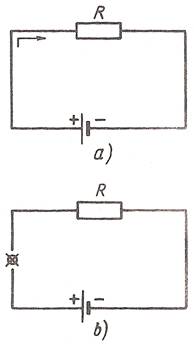 Electric Circuit
This is a circuit. Its elements are a voltage source, a resistor and a conductor. The circuit consists of a voltage source, a resistor and a conductor. A voltage source supplies current. A resistor reduces current. A conductor connects the elements of the circuit.
 Compare circuit a with circuit b. What is the difference between them? Current passes through circuit a while no current passes through circuit b. Circuit b has an open. No current through circuit b results from an open. An open and a short are troubles in a circuit. A trouble in a circuit may result in no current in it.
|
|
|
3. Complete these sentences, using the correct variant:
| 1. Circuit a consists of | a) resistors and conductors. b) a voltage source and resistors. c) a voltage source, a resistor and a conductor. |
| 2. A voltage source | a) conducts current. b) reduces current. c) supplies current. |
| 3. A conductor | a) connects the elements. b) supplies voltage. c) conducts current. |
| 4. A resistor | a) connects the elements. b) supplies current. c) reduces current. |
| 5. No current results from | a) an open. b) a short. |
4. Answer the following questions:
1. What elements does a circuit consist of?
2. What is the function of a voltage source?
3. What is the function of a conductor?
4. What is the function of a resistor?
5. When is there no current in a circuit?
6. What does an open or a short result in?
7. What does no current in a circuit result from?
5. Solve these problems:
1. How much is the current in the circuit if a 60-volt source is connected to a resistance of 1, 600 ohms?
2. How much is the voltage in a circuit having a current equal to 25 amp, if a 25-ohm resistance is connected to it?
3. A 70. 35-ohm resistance is connected to the circuit. How much is the voltage if the current equals 4. 5 amp?
|
|
|
